 d39835fb09
* Add new gifs for crud builder

* Add links

* Update object-inheritance

* Update variables context file with gif and link. Add object inheritance images.

* Update variable environments article.
159 lines
4.4 KiB
Markdown
159 lines
4.4 KiB
Markdown
# Object Inheritance
|
|
|
|
## What
|
|
|
|
* A **model** contains properties that can be reused and referenced by endpoint
|
|
definitions, shared objects, and other models. For more information on what
|
|
models are and how they can be used, please see the API model overview
|
|
[here](/modeling/modeling-with-openapi/api-models).
|
|
|
|
* **Inheritance** is when a model derives its properties from another model.
|
|
|
|
* When a model inherits properties from another model, the model being inherited from is
|
|
known as a **base type** (or parent). A model that is inheriting
|
|
properties from a base type is known as a **derived type** (or child).
|
|
|
|
* When a base type inherits properties from another model, any derived types
|
|
will also automatically inherit the properties as well. For example, if model
|
|
C is a derived type of model B, and model B is a derived type of model A, then
|
|
model C is also a derived type of model A. In mathematics, this is known as
|
|
the [transitive property](https://en.wikipedia.org/wiki/Transitive_relation).
|
|
|
|
* To specify that a model should inherit from a base type, use the **allOf**
|
|
option (under "Combination Types") when building the model. By specifying
|
|
allOf and referencing the base type, the model will automatically inherit all
|
|
of the parent model's properties. A model can also inherit from multiple base
|
|
types as needed.
|
|
|
|
## Why
|
|
|
|
* Inheritance makes your API design more compact. It helps avoid duplication of
|
|
common properties and fields, reducing the complexity of the specification and the chance of errors.
|
|
|
|
## Best Practices
|
|
|
|
> Avoid using contradictory declarations such as declaring properties with the
|
|
> same name but dissimilar data type in your base model and derived model.
|
|
|
|
### Example
|
|
|
|
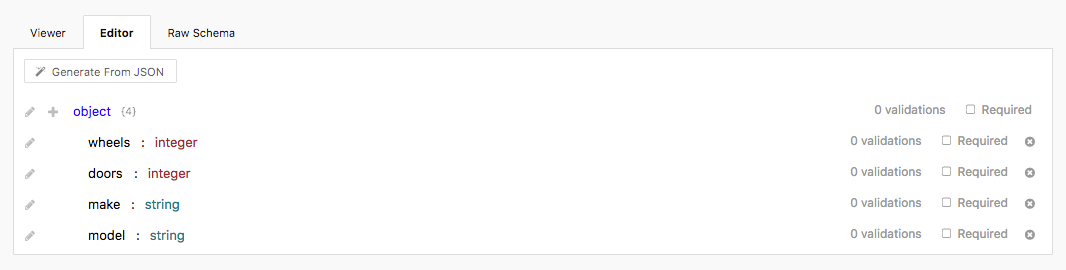
As an example, imagine you are creating an API that stores and categorizes
|
|
different types of vehicles. To begin working on the API, you will need a base
|
|
"car" model with a few attributes that are common across all vehicles. This
|
|
might look similar to:
|
|
|
|
|
|
|
|
The JSON schema will be:
|
|
|
|
```javascript
|
|
// the car base type
|
|
{
|
|
"type": "object",
|
|
"properties": {
|
|
// number of wheels
|
|
"wheels": {
|
|
"type": "integer"
|
|
},
|
|
// number of doors
|
|
"doors": {
|
|
"type": "integer"
|
|
},
|
|
// brand of car
|
|
"make": {
|
|
"type": "string"
|
|
},
|
|
// model of car
|
|
"model": {
|
|
"type": "string"
|
|
}
|
|
}
|
|
}
|
|
```
|
|
|
|
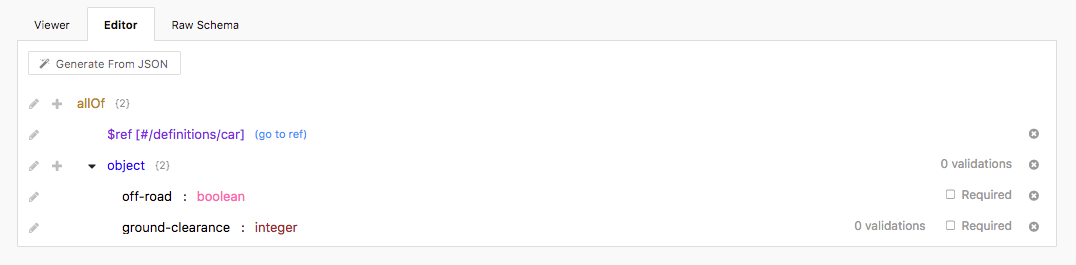
Now that we have a base type model, we now need a derived type that extends the
|
|
base type. Since we're dealing with cars, let's create a model that defines a
|
|
SUV type (or a Sport Utility Vehicle):
|
|
|
|
|
|
|
|
The JSON schema will be:
|
|
|
|
```javascript
|
|
// the SUV model
|
|
{
|
|
"allOf": [
|
|
// a reference to the car base type
|
|
{
|
|
"$ref": "#/definitions/car"
|
|
},
|
|
// properties that are only applied to the SUV model
|
|
{
|
|
"type": "object",
|
|
"properties": {
|
|
// whether the vehicle can go "off road"
|
|
"off-road": {
|
|
"type": "boolean"
|
|
},
|
|
// the amount of ground clearance
|
|
"ground-clearance": {
|
|
"type": "integer"
|
|
}
|
|
}
|
|
}
|
|
]
|
|
}
|
|
```
|
|
|
|
As shown above, by wrapping our SUV model inside of an `allOf` block, we are
|
|
able to include all of the properties that are included in the car base model
|
|
above.
|
|
|
|
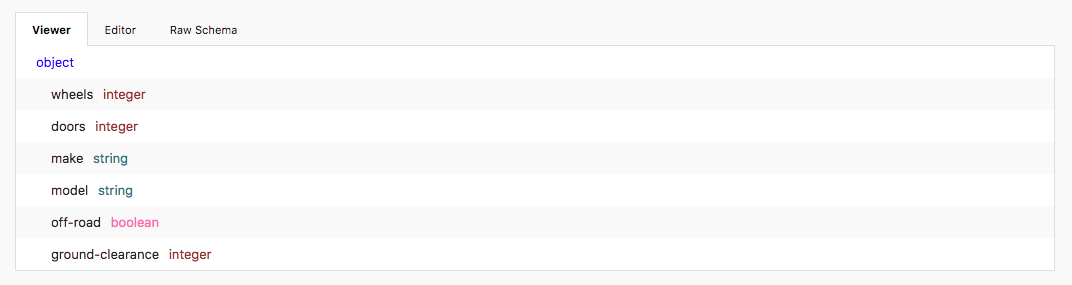
When fully de-referenced (the car reference is replaced with the car
|
|
properties), the derived SUV model will have the following JSON properties:
|
|
|
|
|
|
|
|
The JSON schema will be:
|
|
|
|
```javascript
|
|
{
|
|
"type": "object",
|
|
"properties": {
|
|
// number of wheels
|
|
"wheels": {
|
|
"type": "integer"
|
|
},
|
|
// number of doors
|
|
"doors": {
|
|
"type": "integer"
|
|
},
|
|
// brand of car
|
|
"make": {
|
|
"type": "string"
|
|
},
|
|
// model of car
|
|
"model": {
|
|
"type": "string"
|
|
},
|
|
// whether the vehicle can go "off road"
|
|
"off-road": {
|
|
"type": "boolean"
|
|
},
|
|
// the amount of ground clearance
|
|
"ground-clearance": {
|
|
"type": "integer"
|
|
}
|
|
}
|
|
}
|
|
```
|
|
|
|
---
|
|
|
|
**Related Articles**
|
|
|
|
* [JSON Introduction](/modeling/json-best-practices/introduction)
|
|
* [Adding Validations](/modeling/json-best-practices/adding-validations)
|
|
* [Reducing Duplication with $refs](/modeling/json-best-practices/reducing-duplication-with-refs)
|
|
* [Generating Schemas](/modeling/json-best-practices/generating-schemas)
|